Météo-France averages for Paris count rain on 7 to 11 days in every month of the year, so a three-day trip has a fair chance of one wet day. Paris has a lot of roofed space that is free to walk through: glass-roofed passages built from 1799 onwards, stone arcades around squares, and a bridge with a metro line on top of it.
Galerie Vivienne
The main entrance is at 4 rue des Petits-Champs in the 2nd arrondissement, with others at 6 rue Vivienne and 5 rue de la Banque. The nearest metro is Bourse on line 3. It opens every day at 8:30 am. Closing time is listed as 8:00 pm by the regional tourist board and 8:30 pm elsewhere, so plan to be out by 8:00.
This is the most ornate of the passages. It is 176 metres long and 3 metres wide, inaugurated in 1826, with a mosaic floor, a long glass roof and a glazed rotunda. Daylight comes from overhead along the whole walk, which is even and soft on a face.

Passage des Panoramas and Passage Jouffroy
These two face each other across boulevard Montmartre, so you can cross from one to the other in a few seconds of rain. The metro is Grands Boulevards on lines 8 and 9.
Passage des Panoramas, at 11 boulevard Montmartre in the 2nd, runs south to rue Saint-Marc. It dates from 1799 to 1800 and is open every day from 6 am to midnight, the longest hours of any passage here. It is lined with restaurants and with stamp and postcard dealers, the trade it has been known for since the 1800s. The end near the boulevard is richly decorated and the far end is plainer. Because it stays open late, it is the one to use after dark, when the signs and lamps light the frame.
Passage Jouffroy, at 10 to 12 boulevard Montmartre in the 9th, is open every day from 7 am to 9:30 pm. It was the first Paris passage built entirely of metal and glass. It is about 140 metres long and 4 metres wide. About 80 metres in, it turns at a right angle and goes down some stairs before continuing to rue de la Grange-Batelière.
Galerie Véro-Dodat
The entrance is at 19 rue Jean-Jacques-Rousseau in the 1st, with a second one at 2 rue du Bouloi, a short walk from the Louvre. Metro: Louvre-Rivoli or Palais Royal-Musée du Louvre. The regional tourist board lists it as open every day from 7 am to 10 pm. One local guide lists it as closed on Sundays and public holidays, so do not build a Sunday plan around it.
It was built in 1826 and is about 80 metres long. The floor is a diagonal grid of black and white tiles. The ceiling is only partly glass, and the rest is painted panels, so expect less daylight than under a full glass roof. The low ceiling and the tile pattern were arranged to make it look deeper than it is. It suits a long view down the middle.
Passage du Grand-Cerf
The entrances are at 145 rue Saint-Denis and 10 rue Dussoubs in the 2nd, and the metro is Étienne Marcel. A local guide gives the hours as 8:30 am to 8:30 pm, closed on Sundays.
The City of Paris gives its height as 11.80 metres over three floors and calls its glass roof the highest of the Paris passages. The passage is 117 metres long and 3 metres wide, with a metal frame and glazed fronts on two levels. A vertical frame has room above your head here.
Palais Royal
The garden entrance is at 8 rue de Montpensier in the 1st, by the metro Palais Royal-Musée du Louvre. The garden is open from 8:00 am to 8:30 pm from October to March and until 10:30 pm from April to September.
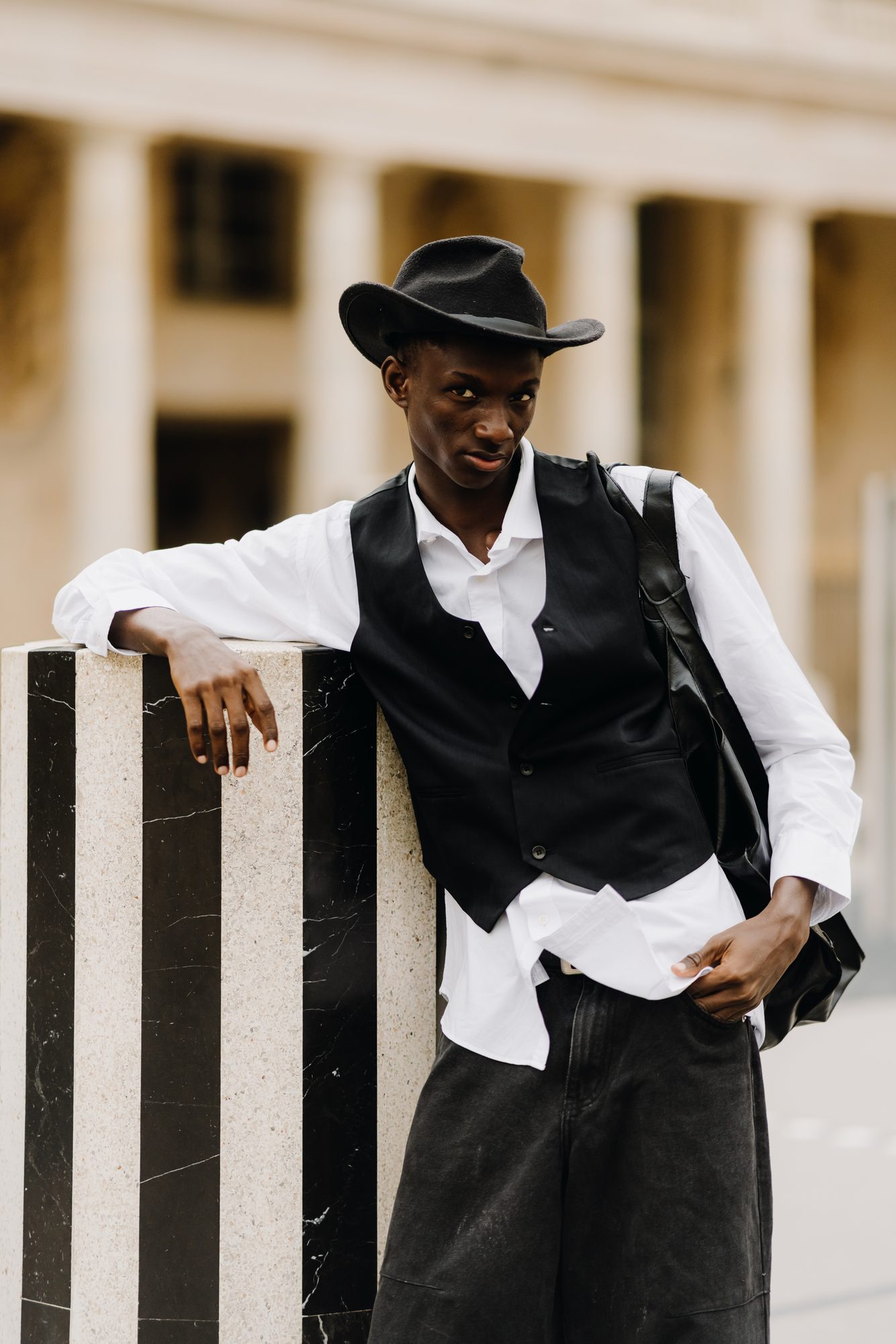
Three covered galleries run around the garden: Montpensier on the west side, Beaujolais on the north and Valois on the east. They were built between 1781 and 1784. You get a long row of stone columns and shop fronts, with the garden as an open background on one side. The light comes from that side only, which shapes a face better than flat light from above.
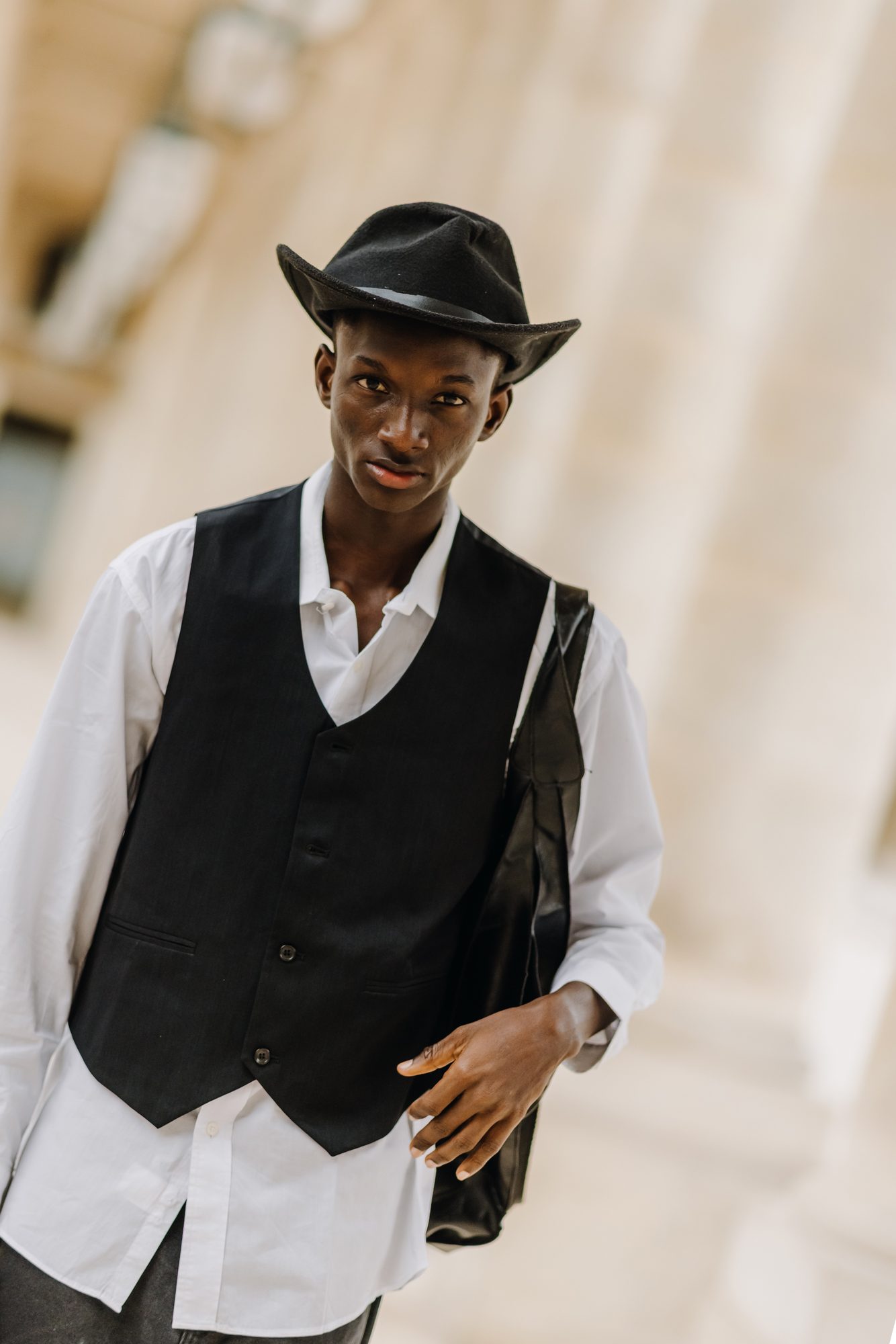
The striped Buren columns are in the main courtyard, under open sky. In rain the courtyard is emptier and the black and white stripes reflect in the wet paving.
Rue de Rivoli
The arcades of rue de Rivoli run from the Place de la Concorde end of the street as far as rue du Louvre, facing the Tuileries garden and then the north wing of the Louvre. Metro line 1 follows the street, with stops at Concorde, Tuileries, Palais Royal and Louvre. The repeating arches make a strong line behind a person, and you can stand under cover with the rain falling one step away.
Place des Vosges
The square is in the Marais, near the metro stations Chemin Vert on line 8 and Saint-Paul on line 1. It is about 140 metres on each side and lined with 36 red brick pavilions built between 1605 and 1612. The ground floor of every pavilion is an arcade, so you can walk along each side under cover. The brick and the white stone trim add colour on a grey day.
Under the viaduct at Pont de Bir-Hakeim
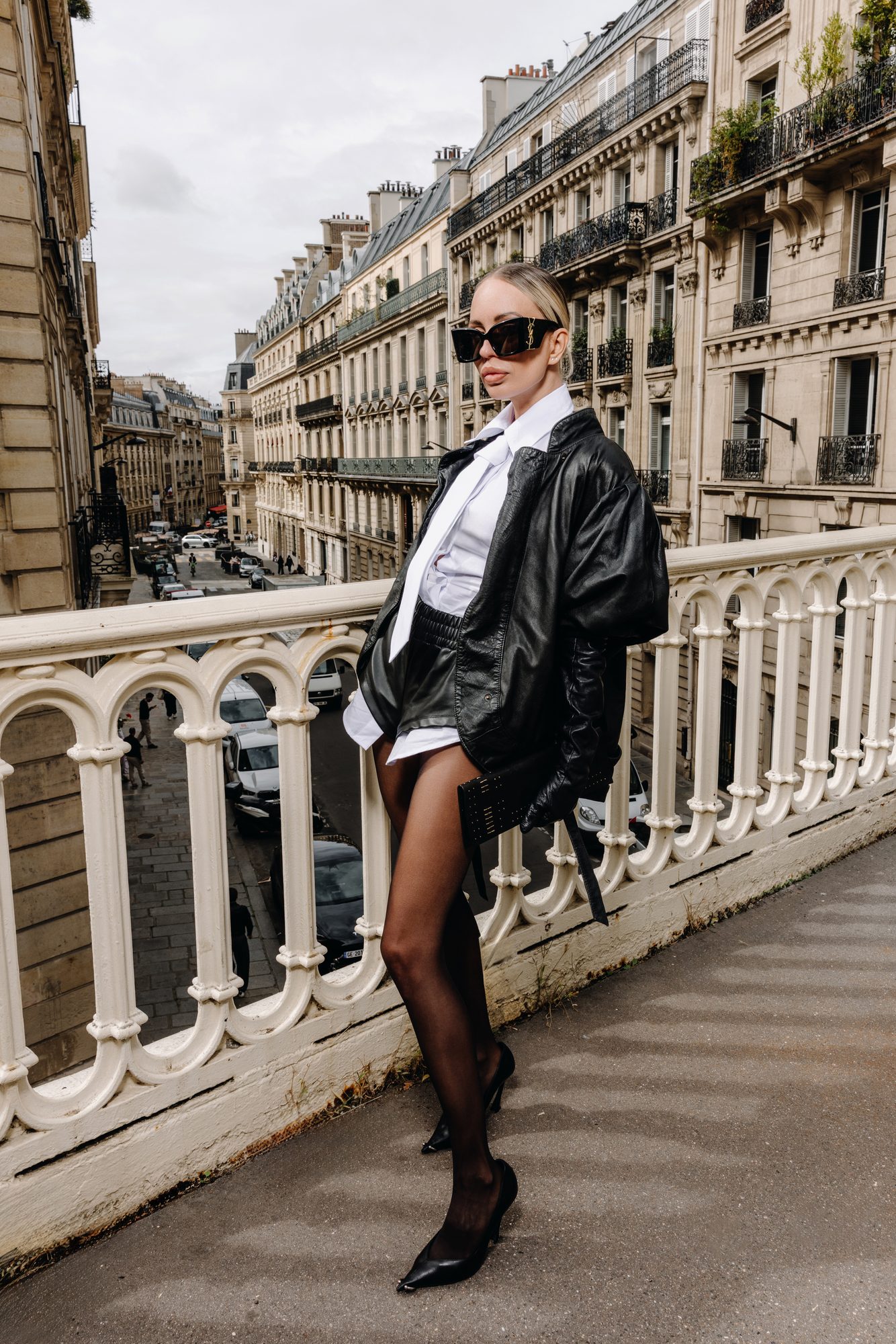
The bridge has two levels. Cars and pedestrians use the lower deck, and metro line 6 crosses on a viaduct above it, carried on a row of metal columns. The bridge is 237 metres long. The viaduct covers the middle of the bridge, which gives shelter in steady rain, though wind blows it in from the sides. Bir-Hakeim station on line 6 is at the left bank end.

What rain does for a frame
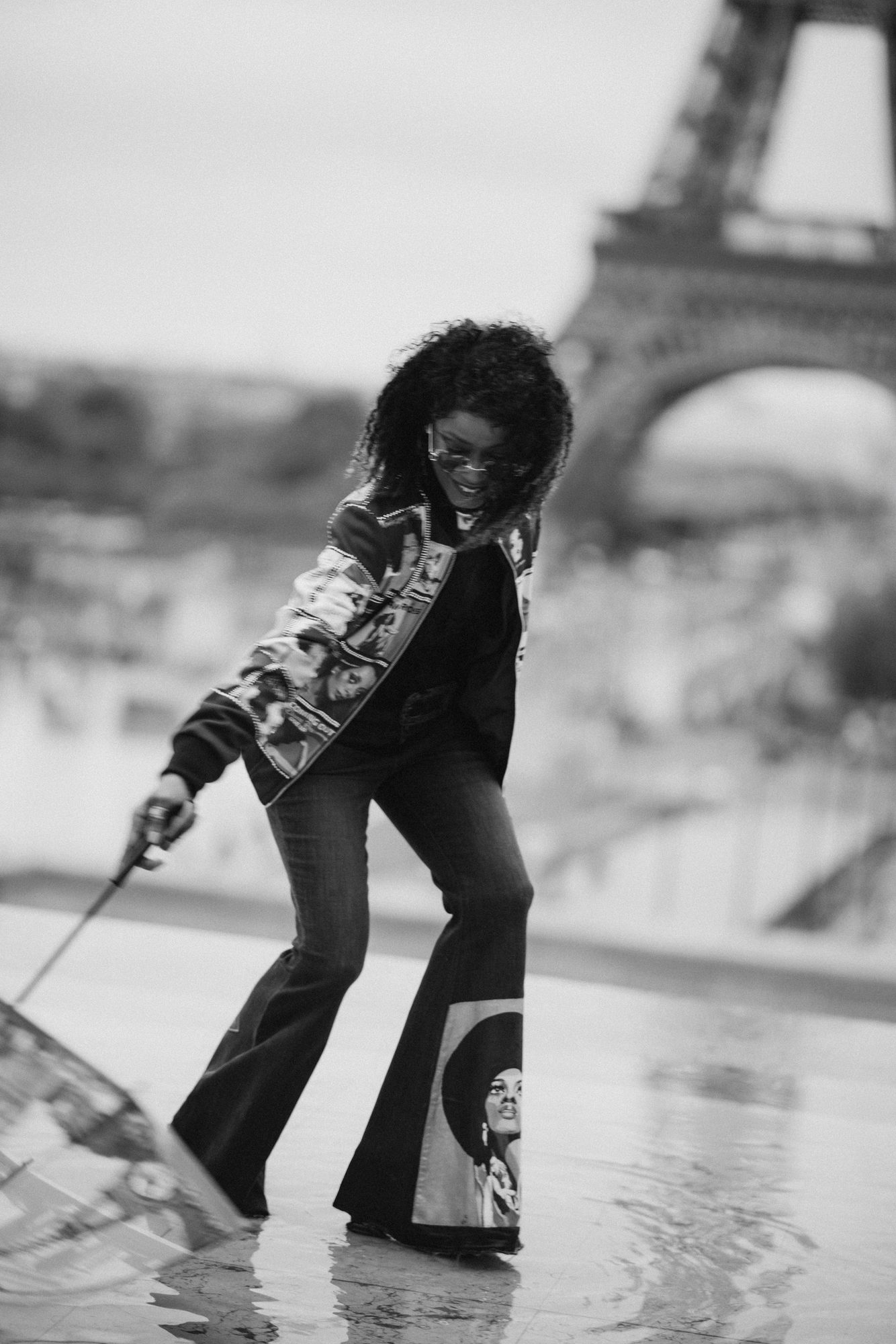
Wet cobblestones and paving reflect lamps, shop windows and lit buildings, so the ground stops being a dark band at the bottom of the photo. The effect is strongest at dusk and after dark, and it lasts for a while after the rain stops. Rain also thins the crowd at open-air spots.
An umbrella is a prop and a frame around the face. A transparent one lets light through and keeps the face visible. A black one gives a clean shape. Avoid logos and bright patterns.

Clothes and hair
Wear a trench or a coat that does not mind water, and avoid suede and long hems that drag on the ground. Light trousers show every splash, so choose dark ones or a skirt above the ankle. Shoes need a rubber sole, because wet stone is slippery and thin heels catch between cobbles.
Humidity undoes loose curls and a blow-dry. Hair that is tied back, slicked or in a low bun looks the same at the end of the hour as at the start. Bring a few pins and tissues.
Phone and camera
Apple rates every iPhone from the 12 onwards IP68, tested to 6 metres of water for 30 minutes, so rain will not hurt one in good condition. Apple also says that resistance decreases with normal wear and that liquid damage is not covered by the warranty. If the phone gets wet, wipe it and do not charge it by cable until it is dry. Apple says to wait at least five hours.
Drops on the screen cause false touches and drops on the lens blur the picture, so carry a soft cloth and wipe the lens before each set of frames.
Ilia Pisarenko photographs portraits, couples and proposals in Paris.